Process optimisation with AI
Most processes can be automated or improved with AI far more than people expect. We show how much in your flows, prioritise what pays off first — and then build the solution with you. The question we start from: how much value are you leaving behind in your processes today?
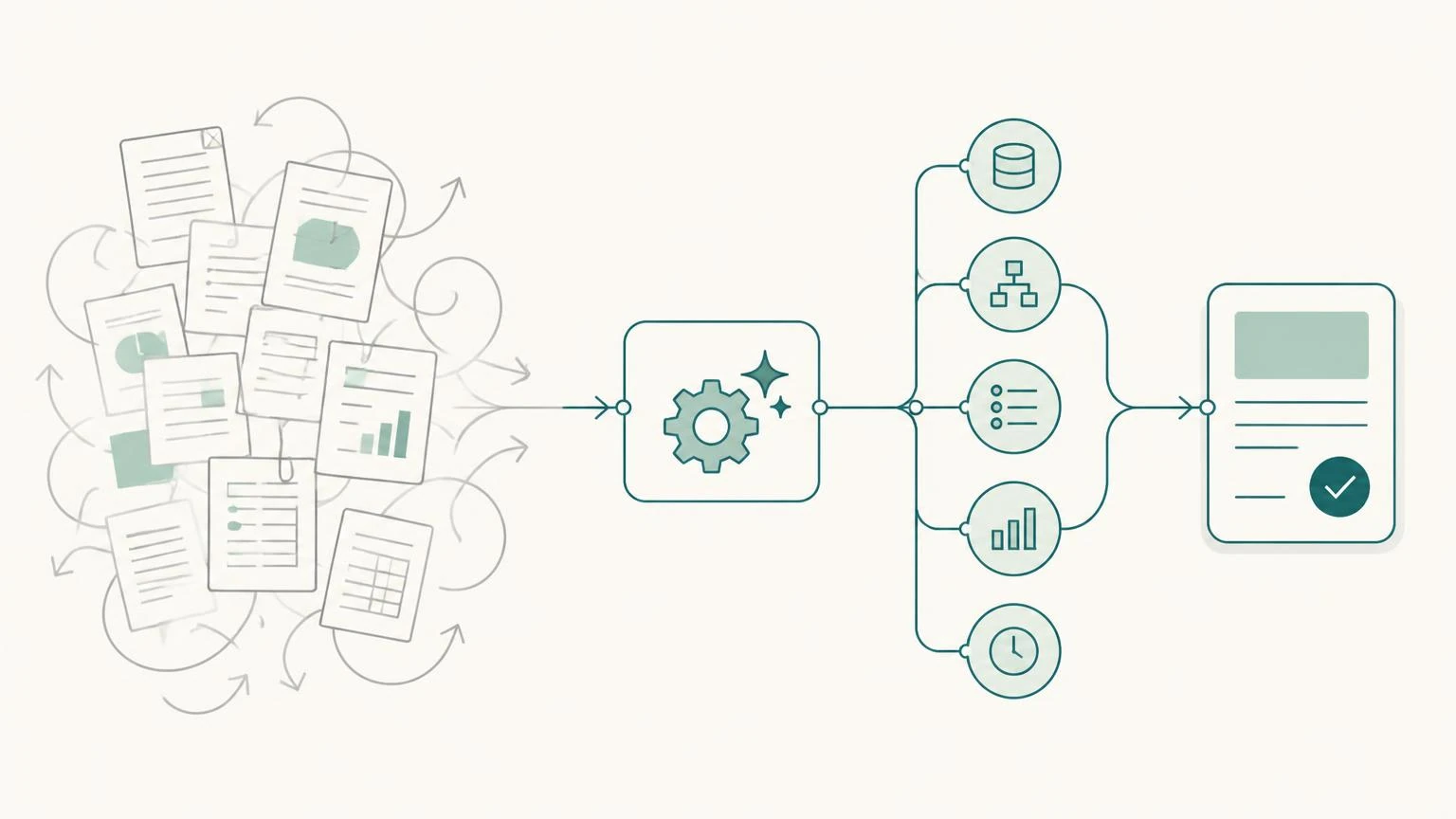
And what we do about it
Four patterns from almost every first meeting — and the track each one turns into.
- 01
Do not know where to start
Assessment → first flow live - 02
Understand AI, miss the cases
Process → ranked AI cases - 03
Many ideas, no prioritisation
Impact × risk → clear ranking - 04
Processes take too long
Measure → build → free time
- 01
Do not know where to start
Assessment → first flow live - 02
Understand AI, miss the cases
Process → ranked AI cases - 03
Many ideas, no prioritisation
Impact × risk → clear ranking - 04
Processes take too long
Measure → build → free time
This much can be optimised
Pick an area — see the shift.
Hours
reading & copying
Seconds
draft to approve
This is how much AI can release
Same case, two outcomes — measured in lead time.
- Email in
- Sorted by hand
- Waits for a personbottleneck
- Data typed in
- Waits for approval
- Reply written
- Closed
- Email in
- Sorted instantly
- Draft reply ready
- A person approves
- Closed
Illustrative example; your flow is mapped as it actually runs.
Mark what you recognise
Pick the patterns that match — the recommendation updates below.
Without help
Press FigFlows and watch the shift.
- Manual steps
- Waiting time
- Different every time
From material to running solution
Four steps. Same partner. What each step delivers.
Analyse
Baseline + potentialWhat is done today — and how much AI can take over.
- Process reviewFollow selected flows end to end.
- BottlenecksDuplicated work and waiting identified.
Questions about process optimisation
Almost always more than people think.
- In flows with a lot of reading, routing, data entry and reporting, large parts of the manual work can be taken over by AI, while people keep the judgement and the decision.
- How much your specific flows can release is something we show concretely before anything is built — and then we build it.
Yes.
- We produce the material, prioritise together with you, build the solution and follow up on the effect in production.
- You do not need to change partner between analysis and build — it is the same team all the way.
The assessment is the means, not the goal.
- A smaller team is normally done in a few weeks, from kickoff to a prioritised plan you can start building on.
- Larger organisations are split into stages so the first solution can be built in parallel.
By measuring the same thing before and after: handling time per case, number of manual steps, error rate, lead time and cost per unit.
- We define the measurement points during the assessment, otherwise the effect cannot be proven afterwards.
No.
- Poor data access is one of the most common obstacles, and the assessment shows which processes can move first with the data you actually have, and where data quality must be fixed before AI delivers.
Where to go next
What could your hours be doing instead?
We always start in your processes, not in the technology — and we do not stop at the analysis. We show how much AI can release, build the solution and take it all the way to production.